

Week 10
Making Paper
Thinking about outside factors that influence your connection to a product had me thinking about it literally in the sense of how the packaging would impact your experience.
I recently read a Tim Ingold chapter called " Materials of Life. He took his students to a beach where willow trees grew to weave baskets out of willow and talked about how the wind and the sand influenced the making process. I liked the intentionality behind it as well as how the place and material were one.
My classmate Nim has made her own paper, and I remembered students in my undergraduate degree making woollen paper, so I set off to make my own. I liked the thought behind the product wrapped in the same material and the link to the place that created it, and how it influenced your experience. I used toilet paper rolls I had been saving as well as some old dye samples from DP1 to create a sheet of woollen paper. It's a strange mix of terribly ugly and incredibly interesting, in a way that makes it beautiful and feels like it has a story to tell.


Base Felt
I prepped a piece of base felt for my next product iterations. Rather than just felting the carded material as one, I split it in half to create a very long sheet, then layered more uncarded wool on top. I had gotten good feedback on the rough wool side, and the thin base card was still smooth enough to laser cut, so this blend worked well.
The process took me 1 hour and 30 minutes, and it weighed 450g. This will be important when I create a final product, so I can calculate production time and material costs to determine whether the margin would be viable.
'Concepts'
Due to an upcoming meeting with Cornwall Park to discuss the products they would like, I needed to create three concepts to pitch to them. From my making, three stood out the most: a coaster, a plant pot mat, and a pocket holder.
These were all cost-viable, had potential to connect into an experience, and were simple enough for the time constraints of size weeks. More importantly, the making process wasn't going to consume all my time and take away from the connection and understanding side. The product is a carrier for the story, not the main show- at least for now.



Cornwall Park Consultation
I created a presentation to cornwal park about my direction and showed them my three concepts. This was a great point to stop and reflect on my feedback from last week's formative and revive my research question.
Coasters
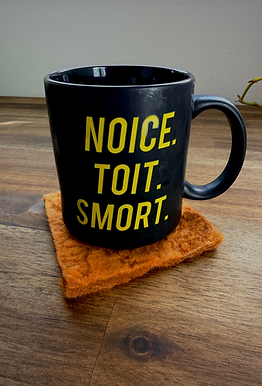
Cornwall Park loved the coasters. Already a top-selling SKU for them, but their coasters are made overseas from a veneer wood.
They currently sell their coasters for $9, so I need to make a coaster for $3-4 to sell it in the $9-12 range.
Based on this new direction, I created a variety of coaster designs to showcase. Their current coasters feature art by a local artist of park trees, so I was given those files to see if I could replicate it on the woolly coasters.
I cut my larger woollen felt in half and fit 24 coasters on it. The laser time took 22 minutes, which is roughly 1 minute per coaster, so renting out a laser cutter for $60 an hour would cost $1 per coaster. This varies depending on the size, though.
I also opted to make the laser slightly less powerful for these coasters, as last time it cut through in some spots. This may have been due to an uneven texture in the wool, but the texture stayed on great after the natural dye, so going a bit lighter would be fine.


Reflection
I am really happy to have a clear direction. With only one week to go before I present, it was important to lock this down. Coasters made of wool work functionally- they will be temperature regulating, and wool can absorb up to 40% of its weight without feeling wet. I can now refine this idea and continue tying it into the park's story. I have an interesting opportunity with the woollen cardboard, but the time it took was just too long, so I will have to make changes to make it viable.