

Week 11
Coasters are dyed!! Four ingredients from Cornwall Park that are available this season: Tanekahu, Lichem, Eucalyptus and Gingko. Ginkgo is especially cool because it only falls once off the tree in May, so that's the only time you can use it to dye. While the dye isn't particularly strong, the story it carries is where the weight comes from.
Larger Scale Laser Cut
After dyeing the coasters, I noticed that the more detailed ones, like the lettering, lost a lot of clarity. That made me feel that, for the coasters, it made the most sense to prioritise the textures, but I loved the way the more intricate shapes looked on the wool.
My thought process was that this was an opportunity to create larger-scale artwork with wool, and that the coasters could link into it. For example, you have a larger image of Euclaptus trees as a purchasable painting, then smaller coasters you could buy that felt like part of the larger painting.
I tested it on a smaller piece to see how much better it got, and had a bit of fun doing it with a Steph Curry photograph.


Light Passing
This was a 5-minute exercise, but I wanted to include it because it has potential for the future. This project goes beyond my thesis as it is part of my business, so I want to continue testing different ways to interact with the material.
The light passes through the wool so beautifully, and it is something that could be applied in the future.


Card Laser Cut
I did some testing on creating a full piece of packaging, but the material was too thick and uneven, so I opted to create tags.
I also had a conversation with my mentor, and he loved the concept of using cardboard coasters because the texture was so interesting and sparked a conversation. I was very sceptical that cardboard would make a very good coaster, but I decided to try it anyway to see if it sparked any other ideas.


Xanthan Gum
The cardboard coaster inspired me to look into a way to seal the cardboard to make it waterproof. I created xanthan gum and mixed it with the wool. I ran some tests comparing 'buttering' the gum onto one side of the material versus soaking it.
The natural wool makes a superior coaster, but perhaps the gum will have a use at another time, like for packaging.


Wool Fest
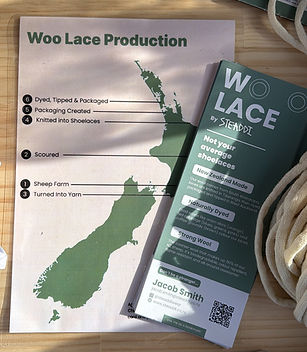
I exhibited my coasters alongside the Woo Lace at Woolfest. While I couldn't get any meaningful user feedback due to ethical constraints, I still had valuable conversations about the coasters. I got a sense of what people would pay for them and whether they would buy them individually vs. as a set.
The lowest price mentioned was 4 for $20, and the highest was q for $15. The most common medium was around $10 per mark, which is doable. A lot of people at the event understand the process that goes into a wool product better than a regular customer, so it is important to communicate this to them.
This week, I read Kate Fletcher's Sustainable Fashion, and she talks about how poverty is effectively an inadequate meeting of a need we have. So, by definition, an expression that is creatively and purposefully not met can create poverty. I had a lot of beneficial conversations at Woolfest about Cornwall Park as a place and how connected people feel it. I think modern products lack a connection to their roots. With proper storytelling, the coaster has an opportunity to really make people feel connected and fulfilled when they buy it.


Reflection
I wanted to create a 'final' range of coasters this week, but unfortunately, the digital felt machine broke, so I was unable to do so. This led me to do more exploration rather than finalised work. While I am disappointed in this outcome, I do acknowledge that I don't have to reach an endpoint because this is an ever-evolving project. Perhaps I was too focused on a proof of concept in a literal sense, when really I should've been leaning into proofs of methods and methodologies I aim to employ for my master's. I did a creative job this week of sticking with material-driven design beliefs and cost considerations while delving a bit into emotionally durable design and place-based connection.