
Cooking With Gas
Week two continued from the learning in week one, with the goal of making 16 artefacts at an A3 scale under similar time constraints. It also introduced new words: delaminate, reconstitute, layer, dissolve, aerate, eviscerate, glaze, amalgamate, substitute, subtract and morselate.
Week One Feedback
During the presentation of my week one work, I received some useful feedback that helped guide my direction for week two. The majority of my feedback was around the natural dyeing side of my work. I usually find that people can relate more to this and offer more feedback than to wool, where the general person has less knowledge. It is also worth noting that a lot of my work from week one was natural dyes, so this could be skewed just because of the volume of people wanting to complement it. Nonetheless, if the goal is to get more people engaged with wool, and having it be a great material for natural dyeing is one of the main reasons, that is still a great thing, so I will continue to naturally dye and see how I can use that to tell a story.
Laser Cut
(15 Min)
I wanted to test laser cutting to see how more precise shapes could benefit future product development.
However, I felt as though perhaps part of the wool is the handmade aspect. There is an interesting line I need to continue exploring around authenticity and professionalism. Regardless, the laser-cut felt was an interesting test.
A secondary 15-minute test I carried out was using the natural dye liquid from the 30 min tests as a paint. This provided some interesting pieces and served as a continuing exploration of material.


Natural Dye
(30 Mins)
Continuing on from last week, I wanted to explore natural dyes further. I redid a lichen dye (was needed for further use in 1-2 hour artefacts) and then experimented with a blackberry dye and another red cabbage dye. Last week I used an older red cabbage, and with a newer one, I got a purple rather than a blue.
Interestingly, the purple in the red cabbage was achieved by not properly colour-fast testing, as you can see in my 2-hour artefact: the purple dye turns blue, which is a far more common colour for red cabbage.
During my Blackberry dye, after cooking the liquid, I split it into a glass jar and a plastic jar and added the fibre to see if the change in heat retention would impact the dye colour. There was a small colour shift, but it was too minimal a variation to be worth noting.


Re Dye
(One Hour)
Continuing on from last week's testing, I wanted to do another re-dye. This time, I wanted to lean more into storytelling. I used my 'dinner' to re-dye my fibres- I made nachos, so I had an avocado pit and some onion skins, which served as my dye ingredients. It is an interesting idea to consider how tying products to moments can enhance connection and emotional durability.
I saw a clear dark colour shift in the lichen dye and a complete colour shift into a yellow from the purple red cabbage, how cool!


White Card
(One Hour)
To carry out some further testing in felting, I needed to card some more material as I used it all up last week
Prep Felt One
(One Hour)
I wanted to continue exploring felting after success in week one, and I have long wanted to find a use for the offset ends I get from my tipping machine when making shoelaces. After running the idea past Dan (Rau worker), we pointed me towards wet felting instead of digital, since the plastic tips wouldn't fit through the machine.
Wet felting is a time-consuming process, and I spent one hour setting up the felt and aligning the fibres and shoelaces where I wanted them to sit.


Prep Felt 2
(One Hour)
Upon finishing my first felt (see end results further down), I started a second prep felt without any added shoelaces. For this felt, I also used non-carded wool to see if it was a necessary step in the process.
The process for this followed the same as the first- creating soapy, non-bubbly water, laying down plastic and putting fibres on top of it, one layer perpendicular to the other, then laying a piece of mesh over the fibres, adding soap and rubbing progressively rougher with your hands.
Shoelace-bet
(2 Hour)
In week one, I created a shoelace alphabet, but I was disappointed in myself for cutting the laces to fit the shapes I wanted. So this time, I used a singular 120cm regular-length lace and aimed to create the alphabet and all the essential symbols without using any cuts, glue, or tape.
Although some parts weren't perfect, this far more authentically represented the motions of a lace and really hit the concept of creating wool awareness through interesting artefacts. Unfortunately, I ran out of time to create this into a typeface, but that is something I will explore next week, as a woollen font serves as an incredibly interesting piece of work.

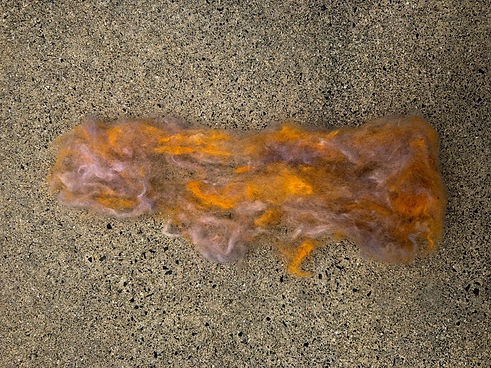
Mixed Carded Wool (2 Hour)
You may have noticed that in my second felt, there was a mix of different colours in the brown wool. Instead of laying these out individually, I took lichen- and red cabbage-dyed fibre and fed it through the carding machine simultaneously to create a mixed-colour layer. I wanted to use more contrasting colours, but this technique could also be used to create gradients.
More excitingly though, you can harvest wool of a coding machine a sheet or as a long strand that can be spun and turned into yarn, meaning I could make a multiple coloured, naturally dyed shoelace.

Shoelace Mat
(2 Hour)
I love how this turned out. The intersection between the felted wool and the amalgamated laces, which feel whole yet connected, creates an incredibly interesting piece that really makes you think. The mix of colours contrasted with the white wool creates a super interesting aesthetic. I will be interested to see if, by removing the tips and digitally felting this, it will evoke the same emotions as it does now.


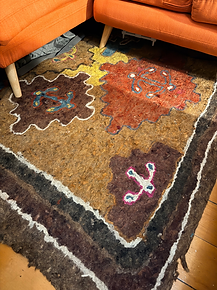
Turkish Inspired
Felt (2 Hours)
My grandparents sell carpets. Growing up, they had a carpet room filled with beautiful colours and patterns- the majority of which came out of Turkey. They were fascinated by the way they were made, how they were dyed, and the stories they carried from there to here. When I moved into my uni flat, my grandma gave me this felted carpet. I feel like it ties us together and speaks to things we both love. I am so interested in the intersection of dark wool and bright colours, and the contrast they create. Most importantly, I love the story that it tells, embedding the narrative that wool is about connection, acknowledging the process and appreciating the material.
Words Used
Layers, Amalgamate
Narrative
How can wool create a statement?. Through my master's, I will bring wool to the forefront of wearables, and my hunch leads me to split that into two directions: 1) creating superior products using wool that make people want to use it, 2) creating awareness around wool to get more people to understand its value. In week one, raw, processed and hot were the words chosen as I wanted to focus on my latter hunch- creating awareness. This led me to create a trident of different approaches: mixed media, leading to a shoelace alphabet; felting, a new medium for me to understand; and natural dyeing, something that helps people connect with wool. In week two, I built on these methods and introduced ‘amalgamate and layer’. I progressed through key learning from week 1 and applied it to new felting methods, creating deeper connections between myself and the fibre, and layered my knowledge with others to create new outputs that continue to push my narrative. How can wool create a statement?

Reflection
Week two allowed for a deeper dive into concepts that I addressed in week one. I introduced more of the narrative aspect to my overall wool awareness concept, specifically with the ties back to my own family. I felt like I did a better job at weaving in my words deeper than just face value and bridging the understanding between them and my practice.
I am excited to continue to explore these concepts next week with lighter restrictions. I want to put greater emphasis on the sharing aspect of awareness, so that something that is interesting doesn't automatically mean it will be seen. I need to ensure that I continue to build on what I have created and layer my knowledge with learning from others to produce artefacts that showcase a deeper understanding of my chosen field.