
The Progressive Dinner
Week Three asks us to create our own time constraints on our work within a total 19-hour constraint. We must also choose two 'contexts' and two 'distribution channels'

Peer Feedback Week Two
My feedback on my week two work wasn't as helpful as I had hoped. I felt like a lot of it aligned with my work, but it wasn't constructive criticism. I think this is because I didn't provide a clear enough explanation in my narrative, so there wasn't enough work for people to give feedback on; hence, it was broad. This also led me to realise that the research question was incredibly broad and simply asked, “How can wool make a statement?” Because of this, I aimed to create a more specific research question for my week three work and create artefacts that continued to be dictated by my ideation and narrowing into a more fledgling “product”
*As I go over this feedback again for hand-in, I have found a piece of feedback that is more helpful now than it was at the time. Sophia said, “I’d be curious to see a marketing on this, e.g., a video”, in reference to my experimentation through mixed media and expressing how wool can make a statement. I now believe that bringing the unseen to life is a big part of my research, and a key way to do so is to tell stories through video. This is something I should experiment with in Design Practice 2.
Research Question
How can strong wool be a catalyst for the prioritisation of the stories behind products, strengthening people's relationships with what they wear, so they are buying more than just a product?

Wet Felt


I wanted to continue with my felting learning from week two and apply my knowledge in week three. I also added embellishments to the wet-felted digital felts I had made over the previous two weeks.
I felt my wets had been too thin, so I used four layers instead of two. The four layers were a success, and I had a far more rigid structure that felt more durable. However, it took even longer than the two layers (which is already time-consuming).
Based on the time, and the fact that the embellishments were heavily altered by the wet felt, I decided that wet felting isn't a direction that is going to create a product that is financially viable. However, It did create something that felt very "authentic" so I aim to discover how I can replicate this feeling but in a shorter time frame.
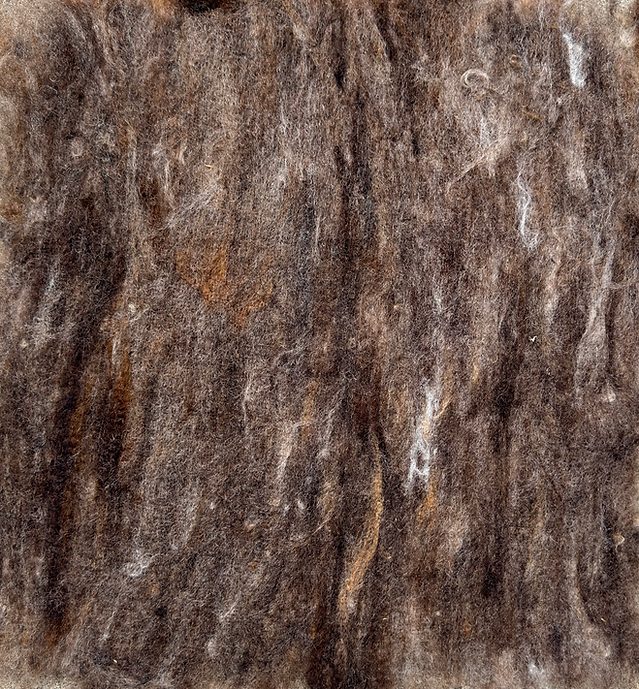
Digital Felt


After understanding how long wet felting took, I wanted to try out an experiment. I aimed to replicate a similar mat to the wet-felted one I had created in week two, but on a digital machine instead. This act of felting (outside of carding and brushing the wool) took only 15 minutes, compared to 2-3 hours for wet felting. This difference would save a significant amount of money while still retaining the use of natural dyes and wool, the core parts of the product.
The question then becomes, does the product tell a story or make you feel anything? Because if not, then the cost savings do not matter.


This week I finalised the shoelace font that I have been working on. After taking all the images last week, I converted each into a font chart, creating a fully functional downloadable font.
Creating this means it can be used in other assets (like the example poster) to make people feel more connected to the product they are buying. Imagine buying a product whose branding is derived from its own elements.
This leads me to explore other ways you can connect people to the product they are buying. I am starting to look at how these elements can make the unseen seen and connect you to the feeling around a product, not just the physical elements.
Contexts & Distribution Channels
Contexts; Narrative & Environment
Channels; Local & Physical
Positioning Statement
How can we use wool to make a statement? This started as the question at the beginning of DP1, and has evolved as I continue to discover what that means. Week one was all about making, guided by raw, processed, and hot, finding ways to work with wool to create a statement, understanding the process, using it as a raw material, and creating something loud/hot. Week two focused on layering my learning from week one and my curiosity about what was to come, to build on what I had created and work towards building artefacts that made a statement. This looked like a rug filled with shoelaces or a font made with shoelaces. I also worked on integrating my knowledge with that of those who have come before me, speaking with technicians, watching videos, and learning new techniques to move me towards my goal. At this point, I had a slight switch in my path. I realised that my overall ethos about bringing wool to the forefront of wearables was about tagging wool into fashion culture, rather than looking introspectively to see how we can grow it within, rather than adding it on. This dictated a large chunk of my learning for week three, where I visited Cornwall park with my artefacts, created with their wool, to show to people walking by, to have conversations and understand why they want to interact with wool, and to continue building on the narrative I was creating. I realised that my goal revolved heavily around traceability and figuring out where the balance sat between one-off locally handcrafted items and mass-produced goods, and where those two mediums could intersect to create an ecosystem where traceability, narrative, environment and ethical production were prioritised while still delivering at a realistic price point that consumers could afford. This led me to explore the differences between wet felt and felt, and if they told different stories, more specifically, could you feel and see time when looking at something? This leads me to where I position my research today. While there is so much more to discover, my research is pulling me towards traceability and narrative. How can we find the intersection between mass-produced and handcrafted to create products that hold a strong narrative, are traceable and allow customers to buy into more than just a product, while still offering at a realistic price point. This means building physical things, but arguably more importantly, the structure that sits behind them.