

Week Eight
Digital Felt
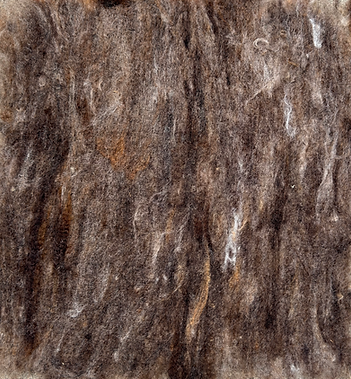
Throughout DP1, I did a lot of felting, and because it is an accessible machine I can use in the textile lab without much sign off and approval, it makes sense for me to use this as a material constraint for my product in DP2. I set off to create a large piece of felt (roughly 80cm x 70cm), that I would use for all my prototyping for my work. I have been interested in Galinas work where she has been talking about how Kimons are made using a simple pattern out of a single piece of fabric, so I thought it would be interesting for me to use a single sheet as a constraint as well.
This ensures I am not being wasteful with what I create, and even though it is protpypoing I am being intentional with my materials which is a key to my research.
Carding process took me 1 hour and 26 minutes, and the felting process took me 45 minutes. I added raw un brushed wool to the top of my carding base before going through the machine which made the process longer. I did this to simulate a sheep's coat and make something that "felt" (no pun intended) like it was apart of the park, which is a goal of mine.


Carding
As I mentioned before, I had spent 1 hour 26 minutes creating my card on a hand carding process. After doing this, I set up a digital carder, which effectively is just doing the hand turning for you allowing you to freely continue to feed the fibre through, speeding up the process.
I was setting this up for the textile department, so I used some merino wool they had, that is not my own, hence the different colour and texture.
This process took me 25 minutes, significantly faster than the hand card. It is worth noting that since merino is finer it was easier to feed through so I will have to consider this and do it with my own wool, but it is also worth noting that this was my first time using the machine and I will get faster.
Overall, setting up this machine was a great success and fits into my narrative of, how can we preserve these historical processes and keep authenticity in the garments we make, while still meeting realistic price points.
Situated Ideation
After creating my felted sheet, I needed to figure out what I actually wanted to make. I headed to Cornwall Park on two different occasions; Wednesday at 10AM and Saturday at 4PM to observe people see why they are using the space and ideate.
I mapped out at two different times because the user pool significantly changes on week days vs weekends. Despite this, I was surprised about how many younger people there were even during the week day. Primarily, I noticed that Cornwall Park was filled with connection, a lot of people in pairs or groups catching up and connecting with each other as well as the nature that surrounds them.
There were some people there was purposes like running or biking, but the majority just wanted to feel connected to the space, which I think is an important concept to consider in my product creation.
I


Reflection
This week revealed what I am calling 'the hat problem'. After sitting in Cornwall Park I observed a large amount of people wearing hats. I made a tally of people that were walking past and whether they were wearing just a hat or hat and sunglasses, just sunglasses etc. I feel like based on my results a hat would be a great product to make and I was happy with my direction of the project. However, upon talking to teachers and peers, I realised that by creating a har I was indirectly designing a product that I felt like should be used within the park, and was that actually the point of what I wanted to do. I realised that my goal was to create a way for common visitors (people that resonate with the space, visit frequency and have a deep connection to it) to be able to bring some the park away with them, so they can be reminded of it when they are not there, maybe they move away or cant get there as often. By creating a hat I was moreso trying to lean too much on my product design and be like what is a 'problem' (not really a problem) that I can see here and what can I make to fit the gap. Because of this, I overcompensated and the got very into the research side of it and trying to define what I mean by everything, taking me too much out of the project. I had a worry that all I was trying to do through my masters was just "good marketing" and I wasn't addressing anything. Next week, I will dive deeper into finding a middle group between those two points while also considering the business sides of my project to create an updated goal moving forward that sits in the middle, rather than out to one side of my thinking.